
In the not so distant past, the music industry revolved around buying albums in physical formats like vinyl records, cassettes, and CDs. Owning music meant owning a physical object. Then the internet arrived and turned that entire system upside down.
Piracy spread rapidly making it incredibly easy for people to download and share music for free. The first attempt to restore order came from Apple with iTunes. The idea was simple. Instead of buying entire albums, listeners could legally purchase individual songs and download them instantly. It was convenient, relatively affordable, and most importantly legal. But even that turned out to be a temporary phase.
Over time, downloading music started to feel unnecessary. Why download a song when you could simply stream it whenever you wanted? Platforms like Spotify and Apple Music shifted the entire industry toward a subscription model where listeners pay for access rather than ownership.
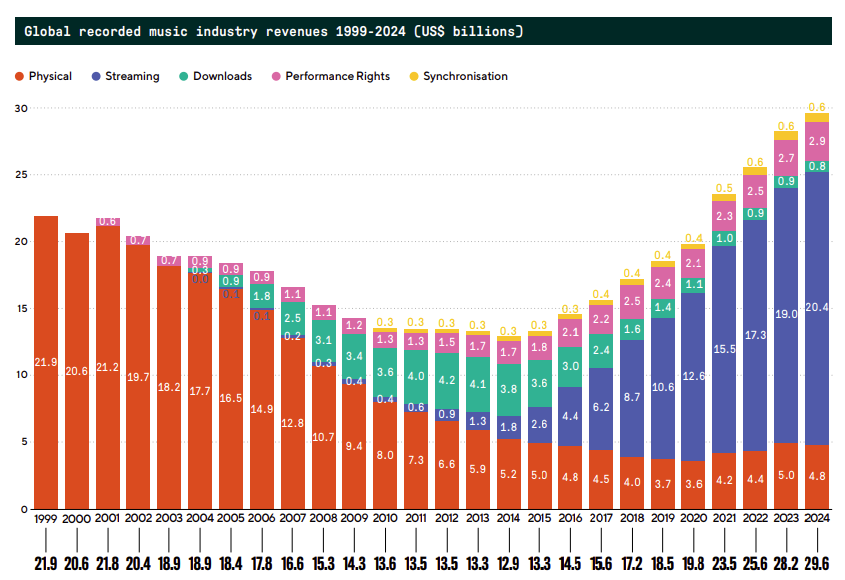
Today, streaming dominates the global music business. Almost 70% of recorded music revenue now comes from streaming platforms. This was one of those rare cases where fighting piracy didn’t come from stricter enforcement, but from making access so seamless that piracy lost its appeal.
The players in the music industry?
At a high level, the global industry revolves around three key players: the artist, the music label, and the streaming platform. In India, however, there is an additional layer that plays a central role: the film producer.
In the film ecosystem, songs are usually not created independently and then sold later. Instead, the film producer commissions the music by hiring composers, lyricists, and singers to create songs for the film. Since the producer finances the process, the producer often controls the rights to the music, subject to the contracts involved.
After the music is completed, the producer may enter into an agreement with a music label. This deal often involves an upfront payment and, in some cases, a share of future revenue. The label then handles monetization by distributing the music on platforms such as Spotify and YouTube, managing licensing, and promoting the songs to increase reach and earnings.
Streaming platforms make money primarily through subscriptions and advertising. That revenue is then distributed to rights holders based on how much their music is streamed.
The Hidden Layers: Master Rights and Publishing?
Every song has three creative elements:
The lyrics, written by the lyricist. The melody, composed by the music director. The performance, delivered by the singer.
Legally and economically, these get grouped into two broad buckets: publishing and master rights.
Publishing refers to the underlying song. This includes the lyrics and the melody. The same composition can be recorded multiple times by different artists, but the underlying publishing remains the same.
Publishing generates money whenever the song is used. This could be through streaming, radio, live performances, or even remakes and covers.
Master rights refer to the actual recorded version of the song. This is the file we hear on Spotify or watch on YouTube. This is usually owned by the film producer in the case of movies, by the label if rights have been sold, or by the artist in independent music.
This distinction matters because revenue from a song is usually split between master rights and publishing rights. The exact split depends on the deal and the platform, but the key question is always: who owns the master, and who owns the publishing?
Who actually Has Bargaining Power?
Previously, recording and releasing a song wasn’t something just anyone could do. You needed access to studios, industry connections, and most importantly, distribution. Labels controlled all three. If you wanted your music to reach listeners, you had to go through them. In return, you gave up ownership of the master.
That trade made sense in a world where distribution was scarce. Today, that world looks very different.
Recording music is far more accessible. Uploading it is even easier. An artist can release a song globally on platforms like Spotify or YouTube without ever signing with a label. Companies like TuneCore and Believe can help artists handle the entire distribution layer. They take your music, put it on streaming platforms, collect the revenue, and pass it back to you, typically for a fee or a small percentage.
So in theory, an artist can now keep ownership, and still be on global platforms. Which brings up the obvious question: why do labels still exist?
The way I see it, distribution was never the end game. Attention is. Uploading a song is easy. Getting people to listen to it is not. This is where labels still have an edge.
They bring marketing and promotion, relationships with platforms and playlists, capital to fund production and scale, and integration with films, brands, and other media.
In India, this becomes even more relevant. A large part of the music ecosystem is still tied to films. Film producers have deep relationships with labels. And labels that control thousands of songs on platforms like Spotify have far more bargaining power than an individual artist uploading a single track.
Even if your song is available globally, it doesn’t really matter until people actually discover it. And discovery, more often than not, is engineered.
Today, anyone can self-publish a book on Amazon. The barrier to entry is almost zero. But publishers like Penguin Random House still matter. While access is easy, distribution of attention is not.
The exception is instructive. Taylor Swift has enough attention that she can dictate terms to labels. She can threaten to pull her catalog. She can re-record her albums. She’s playing a different game because she already won the game of getting people to listen. But Taylor Swift is one person. The rule is everyone else.
Globally, close to 70% of all music is owned by three labels: Sony, Universal Music, and Warner Music. This concentration of ownership means these labels hold extraordinary bargaining power. A music streaming platform cannot afford to lose them. Losing one of these labels doesn’t just mean losing a few artists. It means losing over a million songs. It’s like Spotify trying to operate without the Beatles, Coldplay, The Weeknd, and thousands of others simultaneously.
The same dynamic plays out in India, just with different players. T-Series and Saregama benefit from their catalogs the way Sony and Universal do globally.
Where AI Actually Matters
If streaming solved distribution, AI is starting to reshape creation and decision making. But not all AI is the same.
Predictive AI: Quiet, but Powerful
The more immediate impact of AI in music isn’t in creating songs. It’s in deciding which songs get backed.
Labels like Saregama are already experimenting with predictive models that estimate how a track will perform over time. The idea is simple. Feed the model a dataset with multiple variables. BPM, artist history, genre, performance of similar tracks, early social media traction. The output is a prediction. How much revenue is this song likely to generate?
The beauty of this is not that the model is always right. It won’t be. The beauty is that it is consistently useful in a business that has always been stubbornly subjective.
Instead of a small central team deciding what gets funded, decision making can move outward. Regional teams, younger executives, people closer to the ground can take calls on local music. The model becomes a reference point. It says this song is likely to generate a certain outcome. The human on the ground either agrees or disagrees, but now that disagreement is explicit.
The role of AI here is probably not to find the next hit. It is to make sure the misses are less expensive.
Generative AI: Powerful, But Messy
Then there’s generative AI. This is the more visible side. Tools that can write lyrics, compose melodies, and even replicate voices.
In theory, this should make music creation dramatically cheaper and faster. But it runs into a more fundamental problem: ownership.
If a model is trained on existing songs, who owns the output? If it sounds like a known artist, who gets paid? If it borrows from thousands of tracks, where does originality begin and end?
Right now, those questions don’t have great answers.
My 2 Cents on Music labels:
I initially liked this space precisely because it seemed uncorrelated to the rest of the economy. People listen to songs during recessions. During bear markets. During pandemics. It’s a recession resistant business, or so the logic went.
It took about five minutes of actual digging to realize that while the consumption of music is recession-resistant, the monetization absolutely isn’t. Advertising revenue reduce when the economy contracts. And for music labels in India, advertising is still a meaningful portion of the revenue mix.
In the West, subscriptions dominate. That creates a predictable, recurring revenue stream that should be pretty inelastic. India’s music industry is still in transition. Growth relies on a few things:
Internet & smartphone penetration
Still growing, but no longer explosive. Most of the easy adoption is already behind us.Paid subscriptions scaling up
Small base, exponential growth. If pricing stays low and free tiers get restricted, this can meaningfully lift industry revenues.Better monetization via social platforms
Platforms like Instagram and YouTube turn music into an input for content rather than the end product. As monetization improves across these platforms, the same song can generate revenue in multiple contexts, which should gradually translate into better unit economics for labels.Live events & fandom
As the world becomes more digital, live experiences become more valuable. Strong fandom built through concerts feeds back into streaming and extends a song’s longevity. It also explains why many labels are moving into artist management, to capture a larger share of that ecosystem.
The risks are fairly straightforward, but meaningful. Subscription growth may not scale as expected, especially in a price sensitive market like India where users are used to free access. A slowdown in advertising would directly impact platform revenues and, in turn, payouts to labels. AI adds another layer of uncertainty, both by increasing the supply of music and by blurring ownership through copyright concerns. At the same time, labels risk overpaying for content in an increasingly competitive market, which can compress returns. And finally, as artists gain more leverage, particularly those with established audiences, they are likely to push for greater control and a larger share of the economics, gradually shifting power away from labels.
The industry is evolving, but the balance of power will continue to depend on who controls attention, ownership, and distribution.
Thank you for reading.
Disclaimer - This is for informational purposes only and reflects a general understanding of the industry, not investment advice. Please do your own research and consult a qualified advisor before making any investment decisions.
Cover image taken from Unsplash