
I’ve always been a bit obsessive about documentation. Not in a productivity guru way. More in a slightly unwell, I’d quite like to remember what I thought and why sort of way. Over the years I’ve cycled through solo WhatsApp groups, Google Drive, Notion and, more recently, Obsidian.
I’ve tried to be consistent too. Mental models, investment theses, book notes, interesting ideas. The habit has always been there. The system never quite was. Or maybe it was and I just got bored halfway through, which feels more likely.
Recently I came across Andrej Karpathy, who talked about using LLMs not to write code or answer questions, but to act as a kind of librarian. You feed it raw material. It reads everything, builds structured pages, creates interlinkages between related ideas, and maintains the whole thing automatically. The repository gets smarter every time you add something new, which already makes it more dependable than me.
What really stuck with me was one simple idea. The bottleneck to maintaining a useful knowledge base has never been the reading or the thinking. It’s the admin. Updating cross references. Keeping things current. Humans get bored. Or lazy. Or distracted by something else entirely. An AI agent hopefully does not.
So here’s what I’m working on. An Obsidian vault, which sounds more impressive than it is and is essentially just folders on my computer, with a few clear sections, and linkages. Mental models. People and influences. My Value Tortoise writing. Investing research and journals. And a section I’m calling Sparks for things that are interesting but don’t yet know where they belong.
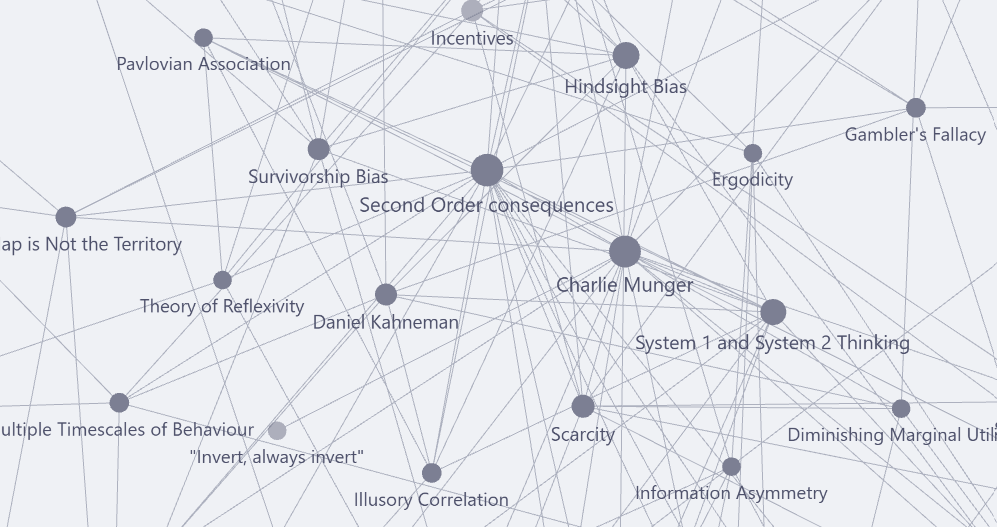
Some of the documentation I still do myself, partly out of habit and partly because some things really do need to stay in my own voice. Investment journals, for instance, only make sense if they capture what I actually thought in that moment, not a cleaner, more intelligent sounding version of it afterwards.
But some of it I’m happy to hand over. If I read something I really like, I’ll just feed it in and let the system turn it into a clean, structured note that lives in Sparks or wherever it eventually belongs.
All of that is useful, but not especially life changing on its own. Where it starts to get interesting is that I can now talk to the whole thing.
Using Claude Code or whatever you prefer, I can ask it how my views on a business have changed over time, which is not a question I could have answered honestly before without a lot of guesswork and selective memory. I can ask it to point out blind spots in my thinking, which feels like inviting trouble but is probably necessary. I can even ask it to read across everything I’ve written and tell me what I actually care about, as opposed to what I’ve just been pretending to care about because it sounded vaguely intelligent at the time.
Has my writing improved. Who do I sound like. Who keeps showing up in my thinking whether I like it or not. (Hello Ana de Armas.) I have my suspicions, but it’s nice to have them confirmed, or gently dismantled.
And it doesn’t have to stop at investing. If you journal, this sort of thing could become quietly indispensable. If I ever get organised enough to document gift preferences for friends and family, I could ask it for suggestions tailored to each person. Which does feel like cheating, but also like a level of adulthood I have yet to reach.
It’s basically a Control F for your brain. Or at least the part of it you’ve managed to write down before getting distracted and opening another app.
I should probably add that I am very far from an AI person. I don’t really know what I’m doing half the time, and a lot of this is still trial and error. So some of you who work more deeply in this field will probably have better, more efficient ways of doing all this, or might not be nearly as impressed by it as I am.
But if you’re anything like me, this feels pretty freaking wild.