
India has about 18% of the world’s population and roughly 4% of its freshwater. On its own, that feels like destiny. A structural shortage. Except it isn’t. India isn’t short of water in the way a desert is. It’s short of water in the way a badly run business is short of cash. The money comes in. It just doesn’t stay where it’s needed, or get used the way it should.
This piece is split into two parts. The first looks at the state of water in India today, where it goes, why so much of it is lost or misallocated, and whether there is a real structural problem beneath the surface. The second shifts gears and looks at the same system as an investor, asking where value might accrue if these inefficiencies begin to correct.
This is a long one, so take your time. Maybe get a glass of water. (I have written about water before, but mostly in passing. This is hopefully more detailed and useful.)
Part One: India’s Water crisis
Every year, India receives roughly 3,800 billion cubic meters of water, almost all of it from rainfall. But most of this water is never really usable. Because of geography, timing, and the way storage is built, only about 1,100 to 1,200 BCM actually ends up as utilizable water, split between surface water and groundwater.
Now, those are very large numbers. And like most very large numbers, they don’t mean very much. It is hard to know what a billion cubic meters of water is supposed to feel like. Is it a lot? Is it not? Should this worry me?
Per capita numbers are a bit more honest. And on that front, India does not look particularly comfortable.
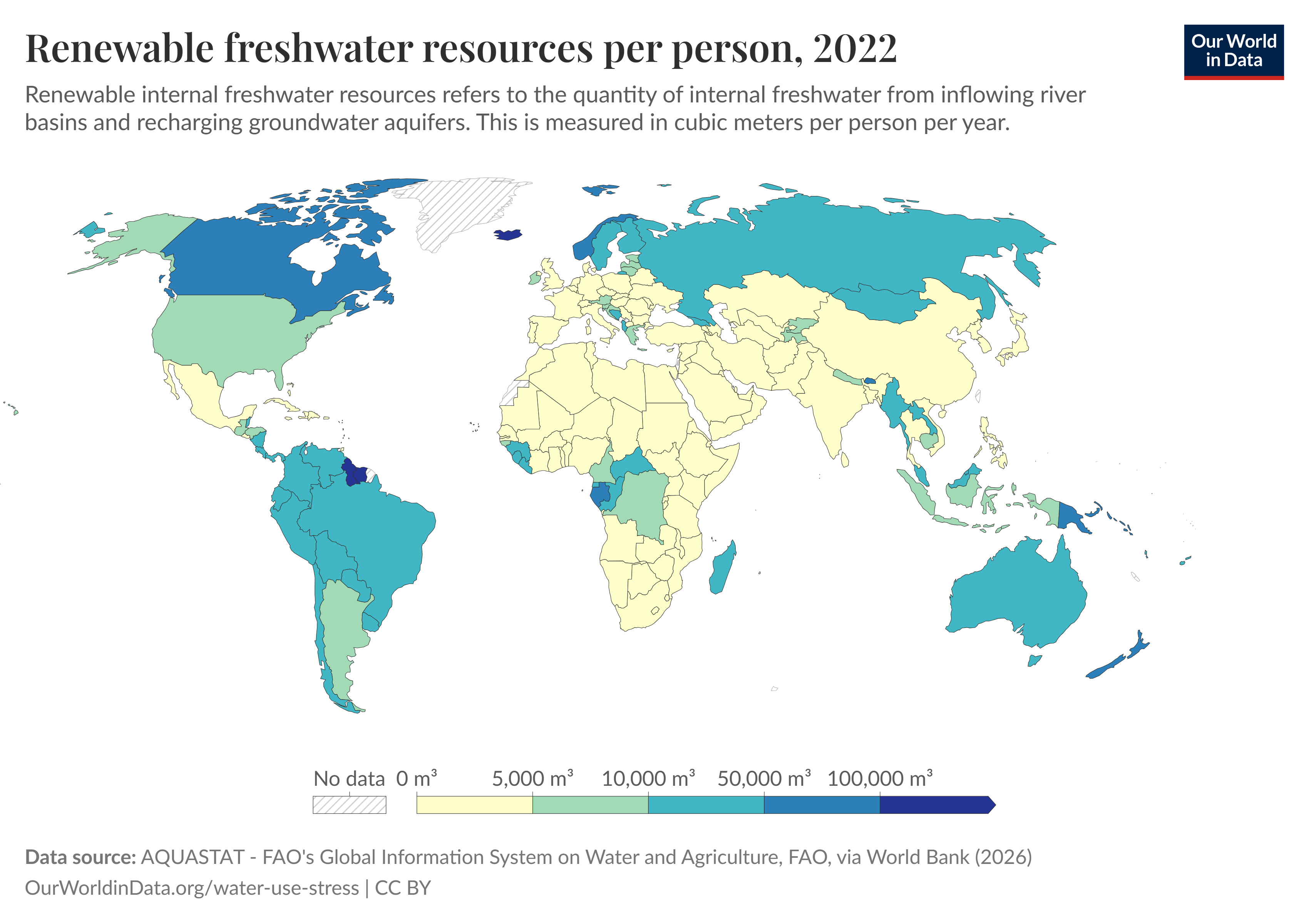
But even this is only part of the story. Because the more interesting question is not how much water India has, but where it actually goes.
The answer is simple. Farming. Mostly
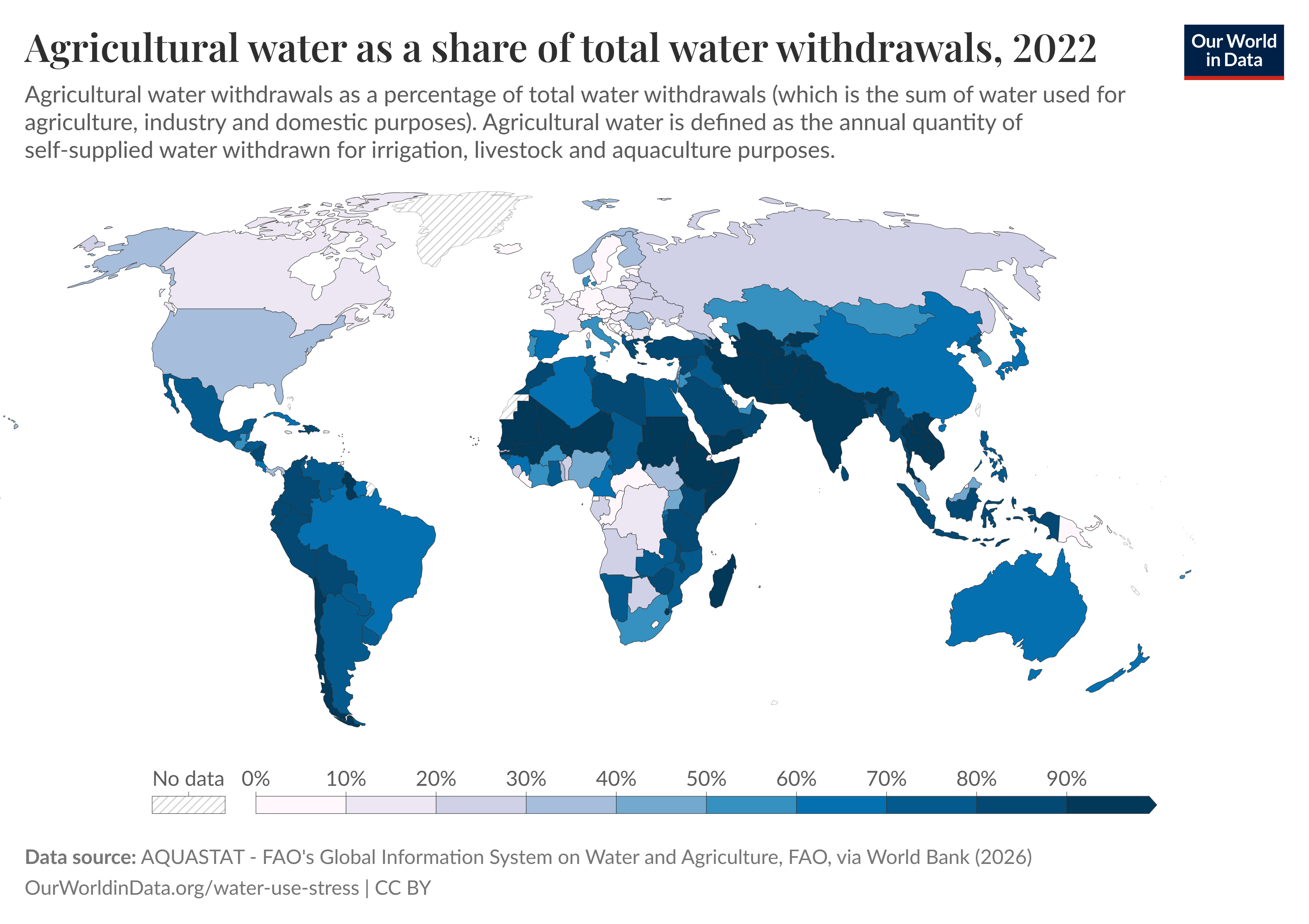
Agriculture consumes somewhere between 78% and 85% of India’s water usage. Industry takes around 6% to 10%. And everything you and I do, drinking, cooking, bathing, living, sits at just 4 to 6%.
Pause on that for a moment. All the direct water use of 1.4 billion people is a rounding error next to what gets pumped onto fields.
And that’s alright. Farming, of course, matters. People need to eat. The Green Revolution was built on irrigation. Nobody is suggesting we stop. All of this would be perfectly fine, if that water was being used well.
Unfortunately, it isn’t.
The crop problem.
India grows a set of crops that are not particularly aligned with its water realities. Rice in Punjab. Sugarcane and cotton in Maharashtra. All heavily reliant on water.
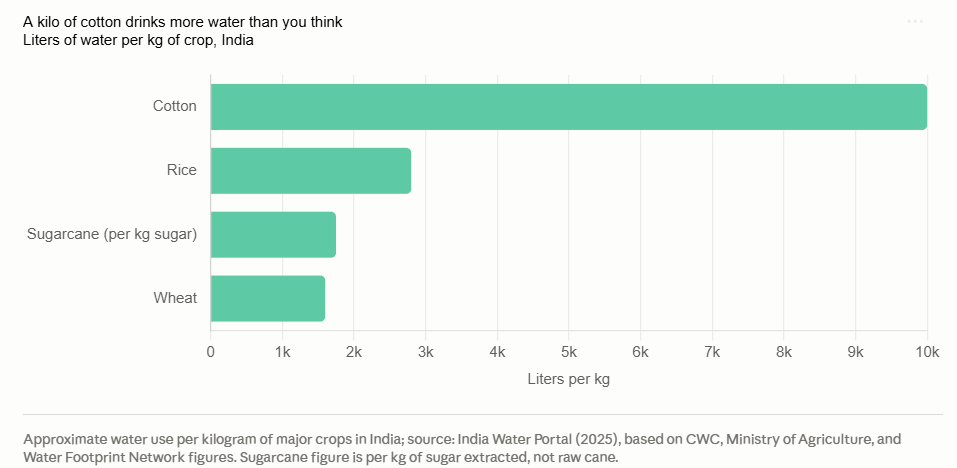
This is not because farmers woke up one day and decided to be reckless. It is because the system rewards this behaviour.
As Mridula Ramesh beautifully points out in her book, some of this misalignment has deeper roots. Colonial policies pushed Indian agriculture toward cash crops that served imperial priorities, not local ecological realities. The logic was simple. Grow what sells. Not necessarily what sustains.
Independent India did not entirely undo this. In some ways, it reinforced it. Procurement systems, subsidies, and infrastructure continued to reward a narrow set of crops, regardless of whether they made sense for the region’s water profile. More recently, ethanol blending adds another layer. While it may help reduce carbon intensity at the margin, it is not necessarily aligned with water realities.
Groundwater, meanwhile, became the silent enabler.
In India, it is effectively a common resource with almost no meaningful limits on extraction. If you own land, you can drill. If you can drill, you can pump. And if the electricity is cheap or free, you can keep pumping.
The result is a system where the rational thing for each individual farmer is to extract as much water as possible, as quickly as possible.
Because if they don’t, someone else will.
This is not reckless behaviour. It is perfectly logical behaviour in a poorly designed system. In parts of Punjab and Haryana, the water table drops every year. Not metaphorically. In actual, measurable metres. The ground is, quite literally, running out of water.
There is no dramatic moment when this happens. Just a slow, persistent decline until one day the well does not work.
The monsoon problem.
At the same time, the supply itself is erratic.
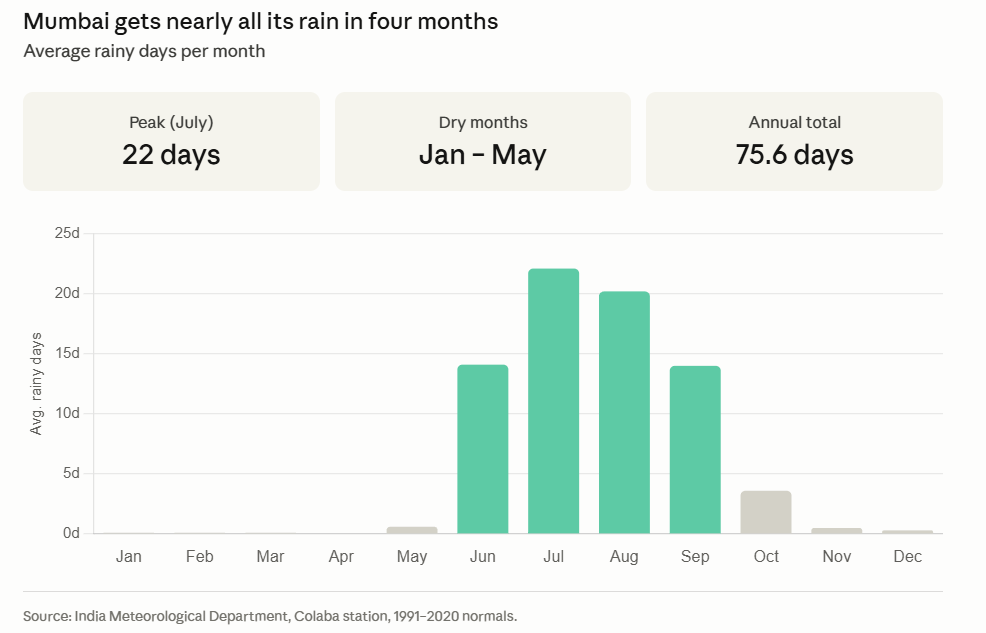
India receives most of its rainfall in a short monsoon window. For a few months, there is too much water. For the rest of the year, not enough.
This has always been true. What is new is how poorly we manage it. Older systems captured water where it fell. Stepwells, tanks, local storage. They were not perfect, but they were adaptive. Over time, those systems gave way to larger, centralised solutions that never quite solved the last mile.
So now a lot of rain falls. And a surprising amount of it leaves.
The urban problem.
Then come the cities.
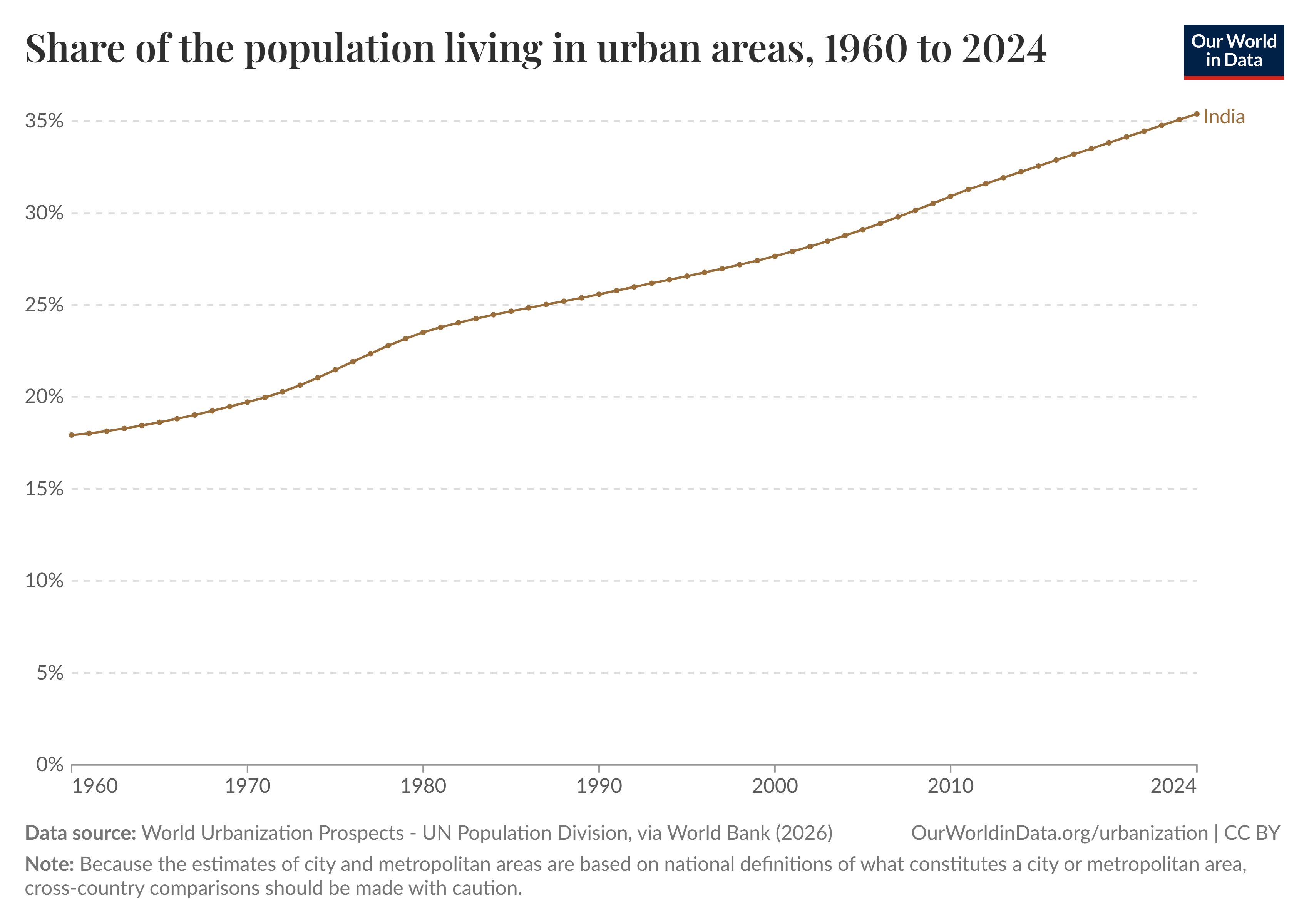
Urban India is growing faster than its infrastructure can keep up. Water demand rises. Supply becomes more uncertain. Sources move further away.
On paper, there are benchmarks for how much water people should receive. In practice, it arrives for a few hours a day, if at all. So people adjust. Storage tanks. Tankers. Filters. Workarounds layered on top of other workarounds.
The wealthy experience inconvenience. The poor experience risk. Which is another way of saying the system redistributes the problem downward.
The energy problem.
Water does not just disappear into farms and homes. It also quietly props up the power system. A large portion of electricity generation relies on water for cooling. Which means water shortages can affect power, and power shortages can affect water supply.
This is not a theoretical risk.
Over the years, water shortages have already forced multiple thermal power plants to shut down or operate below capacity. At one point, 14 of India’s largest plants faced disruptions because they simply did not have enough water to run.
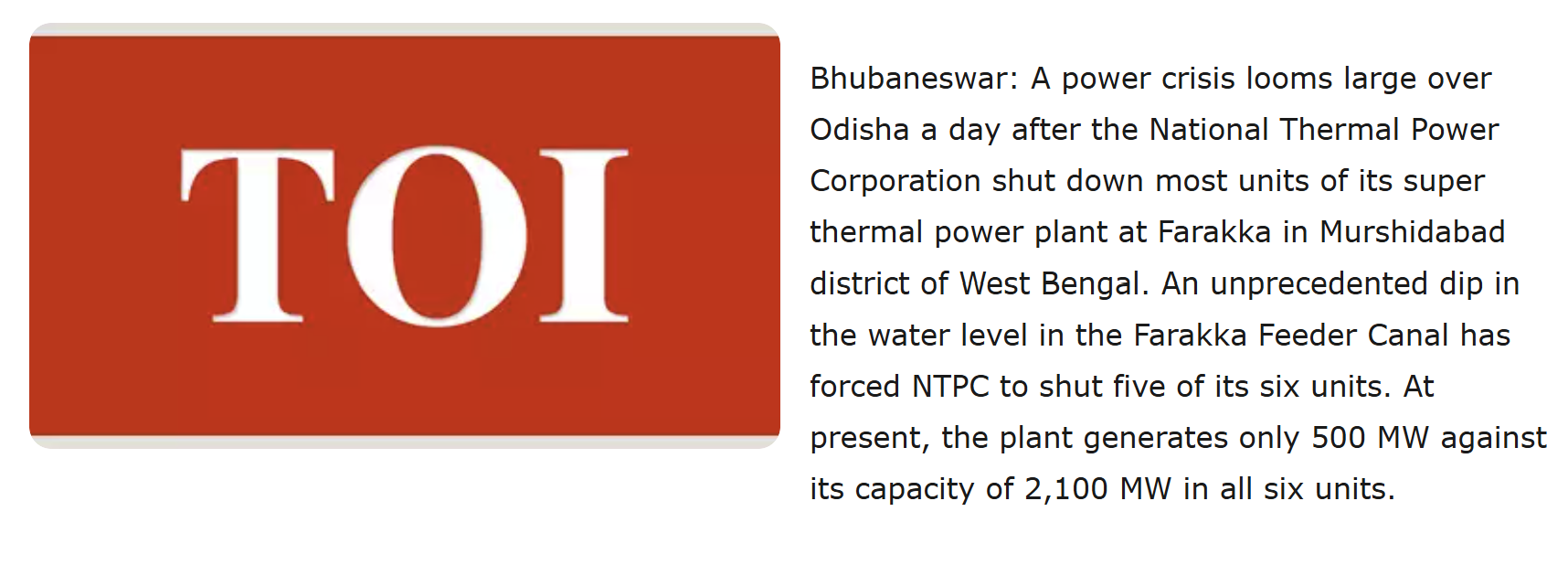
There is no single headline moment. Just repeated stress showing up in different parts of the system. And as demand for both water and power keeps rising, that stress does not go away. It compounds.
The waste water treatment problem.
And then, after all that, we do something quite impressive. We take the water we have used, and make it unusable.
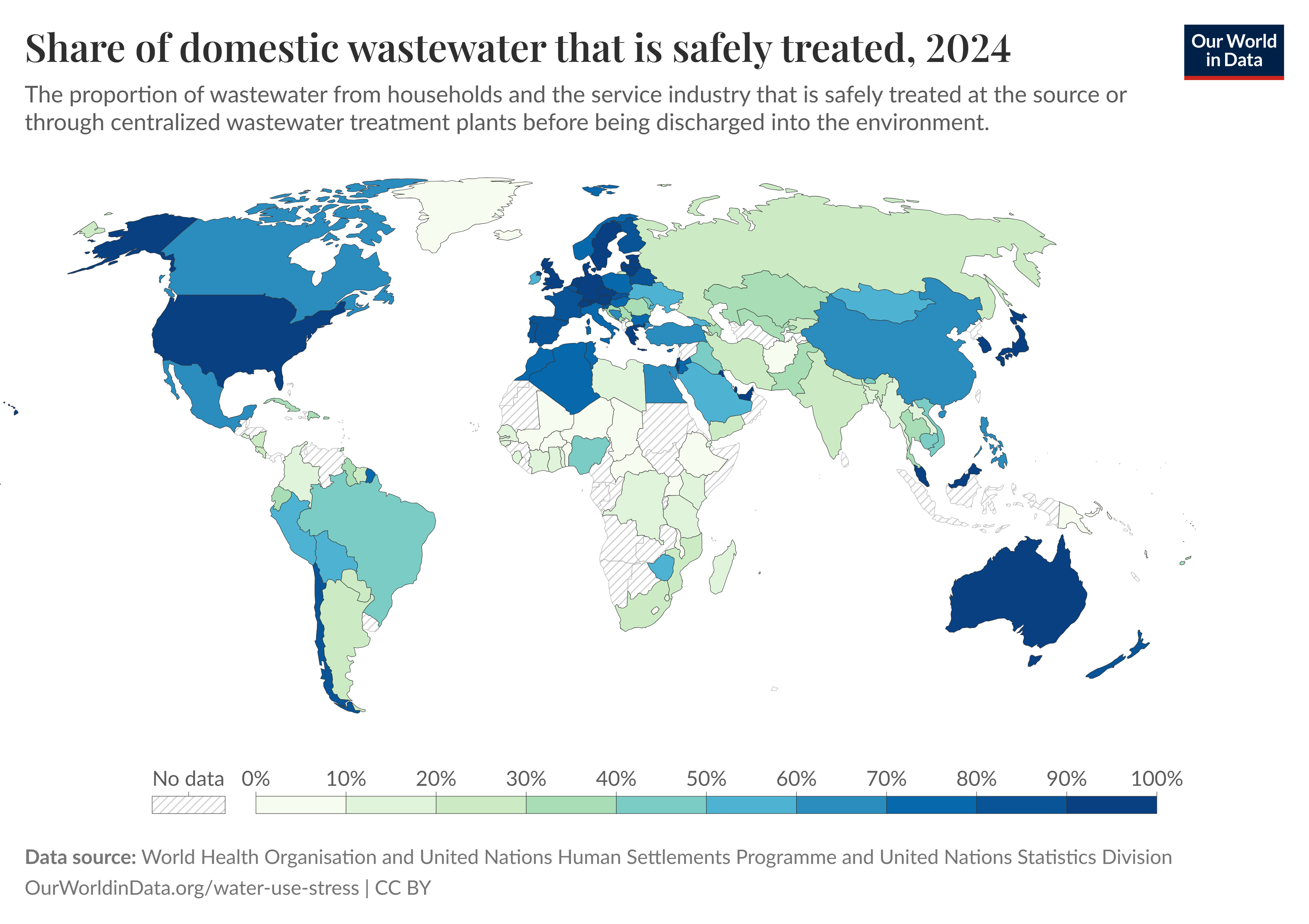
A large share of India’s sewage is not treated. It flows back into rivers, lakes, and groundwater. Which means the same sources we depend on become progressively more contaminated over time.
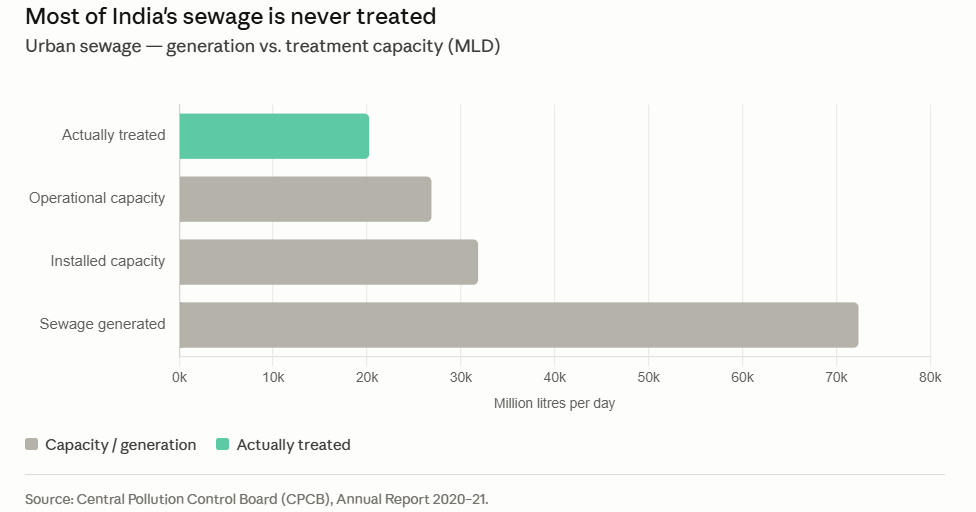
So even when water exists, it is not always usable. Which quietly reduces supply without anyone needing to announce a shortage.
The forest problem.
All of this is made worse by something that does not look like a water issue at first glance. Forests.
Trees are not just decorative. They regulate how water moves through the system. They slow rainfall, help it seep into the ground, and stabilise flow.
Remove them, and the system becomes more volatile. More flooding when it rains. Less water when it does not.
Which is exactly what we are seeing.
The climate problem.
Now add climate change.
Rainfall becomes more unpredictable. When it comes, it comes hard. When it doesn’t, it really doesn’t. Floods increase. Droughts stretch longer. Less water is absorbed. More of it runs off.
It does not introduce new problems.
It simply takes everything that is already fragile and makes it worse.
Part 2: What should I look into as an investor?
Clearly there are a lot of problems. And obviously, a country cannot function when demand for water is pushing up against supply. Especially if it has ambitions of AI, data centres, semiconductors, and the expansion of power grids that underpins all of it. At some point, this stops being an environmental issue and becomes an infrastructure problem. And infrastructure problems, eventually, hopefully, get funded.
Closing this gap means improving India’s water system almost end to end. Treatment plants, pipelines, sewage systems, recycling, storage, leakage control. The unglamorous plumbing that quietly keeps everything else running.
This is not optional spending. It is table stakes. And importantly, this is not some distant forecast. The spending has already begun.
Through programmes like Jal Jeevan Mission and AMRUT, the government is already committing tens of thousands of crores each year toward rural and urban water infrastructure. Add to that river clean up efforts, groundwater programmes, and state level spending, and you start to see the outline of something much bigger.
Will it be executed well? Will it be enough? It’s hard to be optimistic on execution. Water is fragmented across agencies, layered across state and municipal bodies, and slowed down by weak pricing signals and uneven accountability. Even when intent is strong, delivery tends to lag the scale of the problem.
But you also don’t need to track every scheme to see the direction of travel. The broad point is simple. The system is broken, the government knows it, and money is starting to follow.
Water, as a theme, has two characteristics that make it tricky:
Demand is obvious, but monetisation is not
Growth exists, but quality varies widely
So rather than thinking in terms of “water companies”, it helps to break the space into a few distinct value pools.
1. Treatment and Recycling: Demand is not the question
This is the most visible part of the theme.
Sewage treatment plants, industrial effluent treatment, water recycling systems. The core idea is simple. Use water, clean it, reuse it.
In a country where freshwater is scarce and pollution is high, this is not optional. It is regulatory. Which means demand here is not driven by choice. It is driven by compliance.
Companies operating in this space tend to work on a mix of government and industrial contracts, building and sometimes operating these systems.
At first glance, this looks attractive. Long runway, policy tailwinds, clear need. But the nuance matters. A large part of this business is EPC led. Projects are won through bids, executed over time, and paid for with delays. Order books can look impressive, but cash flows often tell a more complicated story.
So the real question is not whether these companies will grow. It is whether that growth translates into durable, high-quality cash flows.
2. EPC vs O&M: Where quality begins to change
This distinction is easy to miss, but it matters a lot.
EPC (Engineering, Procurement, Construction) is about building assets
O&M (Operations and Maintenance) is about running them
EPC tends to be:
lumpy
working capital heavy
margin constrained
O&M tends to be:
more predictable
annuity-like
higher quality over time
Many companies in the water space start with EPC because that is where projects originate. But over time, the more interesting transition is toward O&M.
Because once assets are built, someone has to run them. And in a system as complex and underdeveloped as India’s, that “someone” increasingly needs to be specialised.
The shift from building assets to operating them is where business quality can quietly improve.
3. Industrial Water: The quieter, cleaner opportunity
A lot of the public conversation around water focuses on municipalities and agriculture.
But from an investor’s lens, industrial water can be more interesting.
Refineries, power plants, chemical and Pharma facilities, and increasingly, sectors like semiconductors and data centres, all require:
high-purity water
reliable supply
and often, recycling systems
Unlike municipal water, this is less politically sensitive and more economically rational.
Pricing is better
Counterparties are stronger
Enforcement is tighter
And importantly, downtime is expensive. An industrial plant cannot afford to run out of usable water. This creates a different kind of demand. One that is less visible, but often more bankable.
4. Pipes, Pumps, Valves: The system beneath the system
Then there is the layer that almost never gets discussed.
The physical backbone. Pipes that carry water. Pumps that move it. Valves that control it. These are not “water companies” in the thematic sense. They are industrial businesses. Water is just one part of what they do. But as the system expands and strains, their relevance quietly increases.
Two things matter here.
First, expansion. More infrastructure means more equipment.
Second, and often underappreciated, maintenance. India’s water system leaks. Significantly. Which means demand is not just about building new capacity. It is also about fixing what already exists.
A lot of companies will sit across multiple buckets. The same business might build a treatment plant, operate it, and supply the equipment that keeps it running. So these categories are not rigid. They are a way to think about where value comes from, not a way to neatly classify companies.
Nevertheless, if you follow the sector closely, a few names tend to show up repeatedly. Companies like VA Tech Wabag, Ion Exchange, Enviro Infra Engineers, Jash Engineering, and Denta Water and Infra Solutions have all garnered attention.
In the broader industrial and infrastructure layer, players like Thermax and Larsen & Toubro have water as a small part of their much larger business.
And beneath all of this, in the physical backbone of the system, companies such as Kirloskar Brothers, WPIL, and KSB Limited sit in the pipes, pumps, and valves layer, where water is just one of several end markets.
These are not exhaustive lists, and they are not recommendations. They are simply some of the more visible ways this theme shows up in the listed market.
It is of course tempting to look at all of this and draw a straight line. Big problem. Large spending. Clear winners. Reality is usually less cooperative.
Execution delays happen. Government spending can be uneven. Order books do not always translate neatly into cash flows. And not every company attached to a theme ends up being a good business.
So think of this less as a list of answers, and more as a map. One of the risks with themes like this is assuming that inefficiency will automatically correct itself. It does not. In fact, systems can remain inefficient for decades if incentives do not change.
So it helps to ask a more grounded question: what actually forces behaviour to shift? In my view, behaviour does not change because it should. It changes when it has to. The real inflection point comes when it starts to make economic sense to care about water. When the conversation moves beyond moral obligations and environmental benefits, and toward actually saving money through better water management.
If you made it so far, thank you for reading. I hope this was helpful. I really urge you to check out Watershed by Mridula Ramesh, if you are keen to better understand India’s water woes.
Disclaimer - This is not investment advice. The information shared here is for educational purposes only. While I’ve tried to ensure accuracy, I cannot guarantee completeness or correctness, and I am not liable for any losses that may arise from using this information. Please do your own research.
Cover image taken from Unsplash